Thoughts of black bear hunting typically conjure up mental images of glassing up avalanche shoots in the Rocky Mountains, or hunting the coasts of the Pacific Northwest and Alaska. Some Missourians may not realize it, but the dream of hunting a black bear is a lot closer to home. Missouri is home to around 1000 bears, and every year since 2021 the Missouri Department of Conservation has hosted a managed draw hunt. If you are resident Missourian then a once in a lifetime hunt could be yours, however there are some things you should be aware of.
Managed bear hunt history
When settlers first arrived in Missouri, bears where common throughout the state in numbers much higher than recent years. These bears weren’t treated with the respect and admiration with which they are today. In those days bears would have been a common sight to see on a pioneers dinner table. The fat and hide would have also been a valuable commodity. Bears at this time symbolized the unruly west, and wherever civilization went, bears had to leave. By the 1900,s black bears had been hunted and often times indiscriminately shot to near extirpation in the state. The legendary Daniel Boone killed quite a few during his time in Missouri. The Lewis and Clark expedition also harvested some bears as they went through the state. Bear culture in Missouri is interesting. Nowadays it is strong, but it wasn’t this way in the states earlier years. Someone would be forgiven for looking at the Missouri seal and thinking that the show me state has always loved its native bruins, however the bears gracing the seal are grizzly bears, which have never resided in the state. The grizzly is supposed to represent guardianship. The Missouri capitol building is also filled with bear iconography, but a lot of it is indistinct about what kind of bear it is. Now, in 2025 bears are everywhere in Missouri, (at least illustrated ones). Any Ozark tourist trap is filled with magnets, postcards, hats, shirts, and knickknacks that behold the image of a black bear. Missouri State University picked a bear to be its mascot when it opened in the early 1900,s. This cultural shift seems to have came after we had pushed the bears towards extirpation in the state. The state of Arkansas must have had a change in heart sooner, because they are the ones that first reintroduced black bears in 1958. these bears where sourced from Minnesota and Manitoba. The ancestors of these reintroduced bears made there way north into Missouri and started repopulating the state. Missouri is still missing one key piece of bear culture, and that is a hunting culture. It is commonly known that a fanatically hunting interest in an animal can greatly bolster the species health. For example the Rocky Mountain elk sees thousands of dollars annually in tag money brought in, as well has organizations like RMEF raising and spending even more on habitat. Arkansas has a fairly strong bear hunting culture, but Missouri doesn’t have it yet. In 2021 the Missouri Department of Conservation wanted to start building that culture by starting a hunt. The hunt is limited draw and caped at a certain quota which depends on research and population surveys. The harvest of this hunt has steadily gone up since its inception. As more Missouri hunters get an opportunity that culture will grow.
How does the draw work?
The first thing that needs to be said about the hunt is that in 2025, (and probably the foreseeable future) you must be a Missouri resident to apply. This keeps the drawing relatively small. Next thing to be aware of is that there are no bonus or preference points, meaning it is a straight up lottery. This gives nobody an advantage of another (unless you are a land owner). The application fee is very affordable at just $10. If you continue to apply year after year you have a good chance of eventually drawing a tag, your odds in 2024 would have been about 15 to 1. With tag allocation trending toward increasing, and application numbers staying about the same, your odds could get better in future seasons. If you happen to be a landowner in one of the three bear management zones, lucky you, your odds are even better. 10% of the tag allocation goes to land owners. All the tags are distributed across 3 bear management zones.
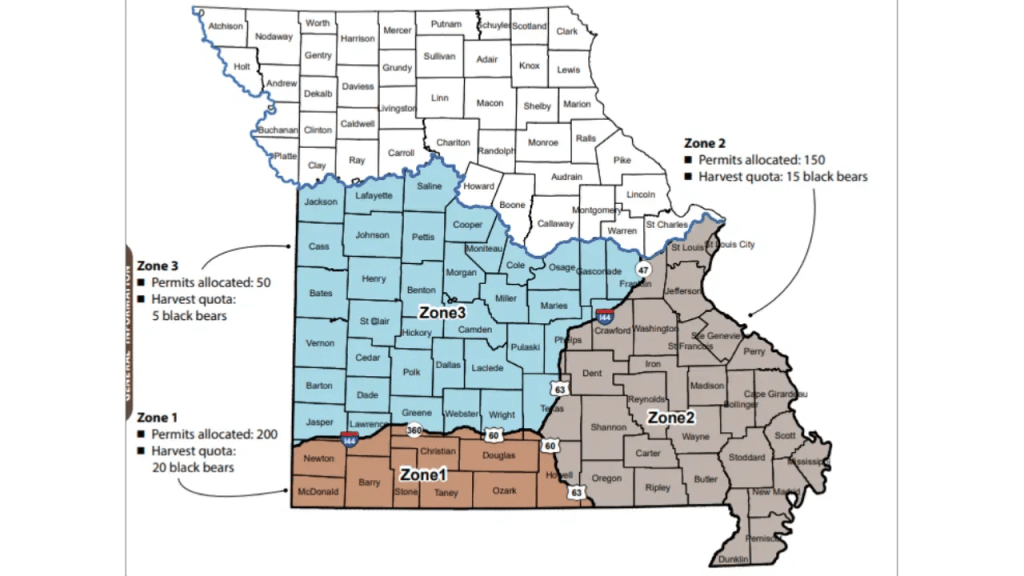
BMZ 1 has the largest bear population, there for gets the most tags allocated. BMZ 2 gets a little less, and BMZ 3 despite being the biggest area gets the fewest tags. In 2025 the Missouri Department of Conservation increased the number of tags to 600. However, 600 bears will not be hunted. there is a quota that harvest is capped at. For 2025 this is 40 bears. If a BMZ exceeds 80% of the quota, MDC will end the hunt the next day. Even though the draw odds are not too insurmountable. You only have about a 6% chance of even being allowed to fill your tag. That’s not even to mention that actual success rates are even lower. In 2024 15 bears where harvested out of 400 tags, putting the success rate at about 3.7%. Needless to say if you are a lucky holder of this tag you need to be okay with not harvesting anything and just enjoy that you get to have an opportunity to be in the woods with a bear tag in hand. It is truly a conservation success story, and you get to be a part of it.
 Big Woods Outdoors
Leave a comment